



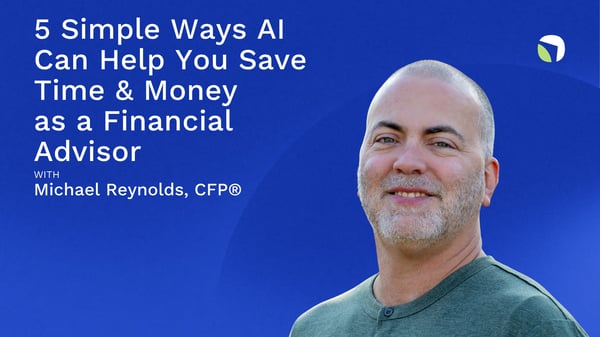
Financial advisors ask two questions about AI: What actually helps my firm today, and how do I stay compliant?
Here's a practical field guide to AI for financial advisors: what to use now, how to pilot safely, and what to avoid.
What AI can (and can't) do for fee-only firms today
Most gains come from reducing administrative work and improving first drafts. You still own the judgment and the final review.
High-value, low-risk use cases
- Meeting notes and summaries: Transcribe calls and generate action items. Review and finalize before saving to your CRM.
- Email drafting: Create a clear reply in your voice, then edit. Good for routine follow-ups, scheduling, and recap messages.
- Document prep: Turn bullet points into a one-pager, agenda, or checklist. Draft plan sections from your outline and financials.
- Data clean-up: Normalize holding names, flag missing fields, and spot duplicates to speed onboarding or account data reviews.
- Marketing support: Brainstorm topics, outlines, and titles. Keep compliance and your expertise front and center.
- Internal SOPs: Convert process notes into step-by-step checklists with owners and due dates.
Use cases that require extra care
- Regulated content: Anything that could be advertising or personalized advice must be reviewed and retained.
- Financial calculations: Do not rely on AI for math, projections, or plan outputs. Use planning software for calculations.
- Research summaries: AI can summarize public information, but verify sources and links before using or sharing.
"Advisors remain accountable for accuracy and compliance. Treat AI as a junior assistant, not an expert."
Quick wins: a simple map of workflows to tools
| Workflow | Tool category | Notes |
|---|---|---|
| Meeting transcription and summaries | Video platform assistants (e.g., Zoom AI Companion), office AI (Microsoft Copilot), general AI with recording features (ChatGPT Enterprise); post-meeting analysis from uploaded transcripts (Claude for Teams) | Enable meeting consent. Review and edit summaries before saving to CRM. |
| Email drafting and recap notes | Microsoft Copilot for Outlook, Google Workspace with Gemini | Keep client confidentiality. Avoid adding new advice without review. |
| Drafting SOPs, agendas, or checklists | General AI in docs (Microsoft Copilot, Google Docs with Gemini) | Good for turning rough notes into usable templates. |
| Data clean-up and categorization | Spreadsheet AI helpers, general AI | Mask PII when possible. Keep a copy of the original data. |
| Content outlines and title ideas | General AI | You provide the expertise. Keep compliance involved for marketing. |
Enterprise versions of AI tools often include stronger privacy controls. For example, OpenAI states that ChatGPT Enterprise does not train on your business data. Microsoft outlines tenant-level protections for Copilot for Microsoft 365. Always confirm vendor claims and contracts.
Compliance, security, and ethics: set guardrails first
You control your risk. Write and enforce a simple AI use policy before rolling tools out. Focus on confidentiality, supervision, and recordkeeping. Managing compliance as an independent financial advisor means staying ahead of new technology risks, not just traditional ones.
Key requirements and references
- Client privacy and data security: Follow Regulation S-P on safeguarding customer information (17 CFR Part 248).
- RIAs must give clients clear privacy notices that explain what data is collected and how it may be shared. Clients must also have the option to opt out of certain data sharing with non-affiliated third parties, particularly when the information could be used for marketing purposes.
- RIAs must create and follow written policies and procedures designed to protect client nonpublic personal information from unauthorized access or misuse.
- Recordkeeping: Preserve required books and records under the Advisers Act (Rule 204-2), including client communications and AI-generated advertisements.
- Marketing claims: The SEC charged two firms in 2024 for misleading "AI" claims in advertisements. Avoid "AI-washing," and ensure your statements are accurate and not misleading (SEC Press Release 2024-36).
- Supervision and review: If AI drafts content intended for clients or prospects, it should go through your standard review channels. Keep your compliance calendar updated.
Vendor due diligence checklist
- Data use and retention policies, including model training
- Security certifications (SOC 2 Type II, ISO 27001) and encryption
- Ability to sign a DPA/BAA, if applicable
- System access controls and audit logs
- Availability, SLAs, and incident response commitments
Consider NIST's AI Risk Management Framework for a practical way to structure governance and controls (NIST AI RMF 1.0).
Expected impact: time back for planning and clients
Independent studies suggest significant time savings on common knowledge work tasks. Microsoft reported that early users of Copilot completed tasks faster and felt more productive (Work Trend Index). McKinsey estimates that generative AI could automate or accelerate a significant share of knowledge workers' activities (McKinsey, 2023).
Translate that into simple math for your firm:
- You spend 3 hours a week on meeting notes and follow-ups.
- AI reduces that to 1 hour with no loss in quality.
- At a $300 hourly opportunity cost, that is roughly $30,000 in capacity recovered per year (2 hours x 50 weeks x $300).
Even if the true savings are half that, the payback on an enterprise AI license is clear.
How to start: a 30–60–90 day pilot
Days 1–30: Pick one workflow and set guardrails
- Select a low-risk, high-volume task, such as meeting summaries.
- Adopt an enterprise or tenant-controlled tool (e.g., Copilot for Microsoft 365, ChatGPT Enterprise, or Claude for Teams).
- Write a one-page policy: approved tools, no PII in public models, review steps, recordkeeping.
- Create prompt templates and a review checklist.
Days 31–60: Measure and refine
- Track time saved, revision counts, and error rates.
- Standardize outputs into your CRM templates and SOPs.
- Expand to email drafting or SOP creation once quality is consistent.
Days 61–90: Roll out to the firm
- Train your team on prompts, examples, and policy.
- Add the tool to onboarding. Include monthly audits of output quality.
- Document ROI and decide on the next two use cases.
Prompt patterns advisors can reuse
Good prompts set the role, task, inputs, and output format. Keep client data minimal and never paste sensitive PII into public tools.
- Meeting summary to CRM note: "You are an assistant to a fee-only advisor. Summarize the transcript into: 5 bullet highlights, decisions made, and a dated task list by the owner. Use clear, neutral language."
- Email recap: "Draft a concise client email recapping today's meeting. Include 3 action items, due dates, and the next meeting link. Keep it under 150 words and match an approachable professional tone."
- SOP from notes: "Turn these steps into a numbered SOP with roles, tools used, and quality checks at the end."
Build vs. buy: where to find AI in your stack
- Office suites: Microsoft Copilot and Google Workspace with Gemini add AI inside the tools you already use for email, docs, and slides.
- General AI workspaces: Enterprise versions of ChatGPT or Claude can support drafting, analysis, and document preparation with stronger privacy controls.
- Existing fintech: Many CRMs, planning, and portfolio tools are shipping AI-assisted features. Ask vendors about privacy, recordkeeping, and admin controls before enabling them. Explore top financial advisor tools that can help save time and money across your firm.
What to skip for now
- Unvetted "AI advisors" or plug-ins handling PII without clear data protections or contracts.
- Automated advice generation that bypasses your planning process or compliance review.
- Bold marketing claims about "AI-powered everything." The SEC and FTC have made clear that exaggerated claims can be misleading (SEC, FTC).
Start small, measure, and expand where the impact is clear.
AI can be a real lever for independent RIAs. Focus on workflows that free up your calendar, implement guardrails that protect clients and your firm, and track results. That's how you turn AI from a trend into a time for advice.
