




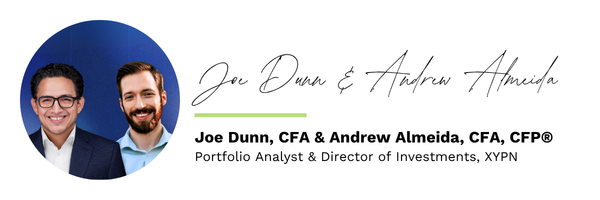
Featuring

Joe Dunn
XYPN

Andrew Almeida
XYPN
The yen carry trade might sound niche, but its impact can reach stocks, bonds, and everyday portfolios.
In this episode of Balanced PM, we unpack how the trade works, why it matters now, and what a potential unwind could mean for investors. We walk through a concrete example of borrowing at low rates in Japan to invest in higher-yielding assets elsewhere, and explain how currency movements can overwhelm the interest earned.
From there, we bring the conversation back to portfolio decisions. We discuss higher yields and the case for fixed income, the risks of reaching for extra return in lower-quality bonds, and why client goals and disciplined rebalancing remain central to our approach.
Our goal is to give you the context to understand the headlines and explain what they could mean for your clients. Join us for a closer look at a seemingly distant trade with connections much closer to home.
Listen to the Full Episode:
Watch the Full Interview:
What You'll Learn from This Episode:
- Understand how the yen carry trade works and why its effects reach beyond Japan
- Learn how a stronger yen or narrowing interest rate gap could trigger an unwind
- Explore what an unwind could mean for U.S. Treasuries, stocks, and market liquidity
- Hear how we’re thinking about higher yields, bond duration, and credit risk
- Put the discussion into practice with context on client allocations and disciplined rebalancing
- Feel more prepared to explain yen carry trade headlines to clients
Featured on the Show:
- Andrew Almeida, CFA, CFP® | LinkedIn
- Joe Dunn, CFA | LinkedIn
- Introducing Balanced PM Blog
- Ep 1 | Breaking Down Stagflation
- Ep 2 | Navigating Uncertainty
- Ep 3 | “Do I own SPCX?!” - Active Decisions Hiding in Passive Investments
- Ep 4 | The Anatomy of Yields
This Episode Is Sponsored By:

Read the Transcript Below:
Joe Dunn: Some advisors and investors have probably heard of the yen carry trade, but for many of us, it probably sounds like one of those esoteric corners of finance that is really only important if you're a sophisticated trader moving money around the world. But here's the thing. The yen carry trade doesn't stay in Japan.
Its tentacles reach far beyond the foreign exchange markets, connecting to global stocks, bonds, and ultimately, the portfolios that many of us manage and personally rely on.
That doesn't mean there's a reason for panic.
But the topic does offer a fascinating window into just how interconnected the global financial system really is, and how something as seemingly distant as Japanese interest rates can ripple through markets halfway around the world. So today, we're gonna unpack the yen carry trade, why it's mattered for so long, what's changing and bringing it back into the spotlight, and most importantly, what any of this could mean for investors like you and I.
Thanks for listening. This is Balanced PM. Welcome to episode five of Balance PM, an XYPN podcast where we prioritize context over conviction to help you make better portfolio management decisions. We're your hosts, Joe Dunn and Andrew Almeida, coming to you from XYPN Sapphire. But before we get into it, our beloved disclaimer. This podcast is produced by XYPN Sapphire, an SEC-registered investment advisor that is wholly owned by XY Planning Network. We're part of the same XYPN family, so we may make references to the larger network. This content is intended for educational purposes only and should not be construed as investment advice. Andrew, speaking of the larger XYPN network, you and I just got back from San Diego this past week, where we got to enjoy this year's XYPN Live.
And I don't know about you, but I had a, tiring but very fun time
Andrew: Yeah. What an event. XYPN LIVE, it's my second. I know this was your first. I would love to get your take on your first experience, but for me, it's getting better every year, and thank you for all the advisors who come spend time with us because it really makes a difference for us. I know there's so much content for them, but even for us to get out of our work from home environment, so many of us work remote, get on the ground with who we work with, it's so valuable
Joe Dunn: Yeah, and I cannot tell you how many times while we were at this conference I had advisors coming up to me left and right saying, "Joe, guys have to do an episode about the yen carry trade. I have so many clients that keep coming to me and saying, 'I'm worried about the yen carry trade.'"
Andrew: Yeah, not a topic at LIVE, but, we have our reasons for talking about it, so we'll get into that
Joe Dunn: Yes, no, I'm absolutely kidding. a single person came up to me and asked about the yen carry trade. I did have one advisor that seemed interested in the topic, but that's 'cause I was the one that brought it up first. But nonetheless, I think it's a really interesting topic. I'm excited to get into it, and even though it is a little bit esoteric and might not be front and center in everybody's minds on a day-to-day basis, especially for a lot of retail traders, I think it's still really helpful to understand what the yen carry trade is.
So if you hear it in the news or see it in the headlines, you have at least a baseline understanding of what they're talking about, and it really does, trickle down to our everyday portfolios. Even it might be a convoluted path that it takes to getting to that impact. it's-- it still feeds its way into our portfolios.
So guess with all that said, Andrew, kinda wanna tee you up to can you just walk us through what's the basic concept of the yen carry trade? Why do people do it?
Andrew: Yeah, the, the yen carry trade, right? First, why are we talking about it? You're right. It's not an everyday thing for advisors and their portfolios, but we definitely wanna give advisors the tools to where if some of the things we're gonna talk about today unfold, that it's not the first time they're hearing about it, or their clients aren't hearing about, "Hey, there's this event going on in the market," and, their advisor isn't ready to, to speak to it.
So we definitely wanna give our network and audience the tools to speak about, the mechanics of what's going on and how it could impact portfolios. What are the basics? The basics of a yen carry trade and, what fund managers who are putting this trade are on are effectively looking to take, a very simple arbitrage concept of borrowing money cheap and lending it more expensive.
So what are they borrowing? They're borrowing in yen, right? Yen carry trade. They're borrowing in yen at lower rates. That is because interest rates are lower in Japan, so borrow low and lend higher. And they're-- Where are they lending? they're lending, back to the US in the form of what? Buying treasuries.
So you're short yen, you're long dollars, that affect
Joe Dunn: assets for that matter
Andrew: or any US assets for that matter. But the idea of the carry trade is to capture the differential on the bond spread between these two countries
Joe Dunn: And so let's, talk about some of the risks that come with that because obviously every investment has some form of risk. Sounds pretty nice to borrow low and to be able to earn a higher rate on those assets on the, that you borrow. So what are the inherent risks that come with this strategy?
Andrew: this economic differential that is low rates in Japan, which had negative rates for so many years, right? Or, extremely low to zero rates, you can get capital very cheap and then lend it for more. you're expecting for this to persist for a very long period of time just to keep raking in that differential.
And a number of hedge funds, they lever up, quite a lot to, to get, more dollars on what might be a narrow spread or some spread of the bonds. the risk? the risk is that the spread of what you're borrowing and lending at narrows, right? That kind of puts pressure on, people who are performing this action or this trade.
The other risk, and the main risk that we'll get into, which can be driven by different factors, is that when converting back to pay your borrowing, rate, which is in yen, that the yen actually appreciates against the dollar. And that's where I think the conversation gets interesting. That's where you could see pressure in markets if this trade begins to unwind holistically, across fund managers who carry a lot of leverage.
Joe Dunn: Now, those words make sense conceptually but can be a little hard to visualize. So for our viewers and listeners, let's walk through more of a, a concrete example to kinda go over that risk that Andrew's referencing. So as he said, you start off by borrowing in yen. So let's say that you borrow one hundred million yen and say that the interest rate on that loan is one percent. The next step of this trade is you're gonna convert that yen into US dollars. So borrow yen, convert to US dollars. there, you're gonna buy US assets. As Andrew mentioned, US Treasuries are a popular destination. So let's say you borrow yen, convert to US dollars, buy US Treasuries, and that yields roughly five percent, we'll say as an example. So back of the napkin math, just being rough in this case, you're earning roughly four percent on that interest spread. So you were buying five-percent-yielding assets, but the original loan was one percent, so that four percent spread is theoretically one of the main components of the return on this yen carry trade. this case, we kinda stop and take a moment to think of where our assets and liabilities are. In this case, you're short the yen because you still owe money in yen. You have to repay that loan eventually, and you're long the US dollar because you used those funds to buy US-denominated-- US dollar-denominated assets. So the problem is, as I've mentioned, investors eventually have to convert their US assets back into yen so they can pay back that loan. So suppose at the start of this trading process, the US dollar Japanese yen conversion rate is one sixty. So that means if we're borrowing a hundred million yen, if we divide that by a hundred sixty because it's every one hundred and sixty yen is worth one dollar, that's how we read that conversion rate. So if we're borrowing one hundred million yen, that actually means that we have six hundred twenty-five thousand, roughly, US dollars to use in US markets. So now suppose that the yen strengthens to one forty-five. So that means now it only takes one hundred and forty-five yen to equal one dollar, whereas previously you had to use a hundred and sixty yen to get one dollar. So now if the yen strengthens to one forty-five, it takes fewer yen to make up one US dollar. at this point, we've already converted all of our yen to US dollars, and so the investor's six hundred and twenty-five thousand US dollars now worth roughly ninety-one million yen. But you still owe the original one hundred million yen that you borrowed. So that roughly, what, nine percent loss. So you owe one hundred million, but the US assets that you converted to are only now worth ninety-one million. So that's a, a roughly nine percent loss, and that completely overpowers that four percent interest rate differential that you were hoping to earn at the start of this yen carry trade. And, that's the real risk that comes with this yen carry trade, is that currency loss can quite easily overpower the benefit of that interest rate spread. And, we'll, circle back to these risks, Andrew, I know, and, we'll kinda put it into more current terms into like what's happening right now.
But I think that's what's important for our listeners to understand now, is that primary invest-investment thesis is earning the interest rate spread, there's a major risk in currency exchange rates shifting. And, if that happens in a negative direction, then that can completely overwhelm that return that you were expecting to get. Question is, why are we talking about this right now? this yen carry trade has been a thing for many, years. but I just wanna tee it up to explain like what's actually happening with this yen carry trade, and really it's creating more leverage. it's, creating more money in the global financial system and, yeah, it's happening on a global basis because who's doing this?
It's not really retail investors. I assume there aren't too many retail investors that are taking part in the yen carry trade, but we have governments doing it, hedge funds, banks, corporations, large and institutional investors. And as I said, the real big takeaway is that Japan has been acting as this low-cost source of capital on a global scale. And it's, really hard to pin down exactly how much money is tied up in this yen carry trade, but estimates are in the trillions, so that's pretty significant. in terms of where this money is going, I know we're gonna speak mostly to the impact on US treasuries 'cause that is a, pretty dominant, for the yen carry trade. But in reality, th- this money's going everywhere. It goes into equities, it goes into bonds, it goes into real estate, public markets, private markets, you name it. Anywhere where someone can earn that differential where they're borrowing at a low rate, and they can deploy that capital somewhere else that's gonna earn them a higher rate of return, like that's, where the yen carry trade is able to go. And yes, we will circle back and talk more-- in more detail about, treasuries. but really we have to do-- know that it, goes everywhere. And, again, just to tie it, all together, the big takeaway that I want people to walk away with is Japan has acted as a low-cost source of capital on a global scale many years. but that brings me to you, Andrew, and I'm hoping you can explain to our audience why now? Why are we talking about the yen carry trade now?
Andrew: Yeah, good point, especially extending it out past like just using the Japan as a funding source for just US treasuries, but actually as a s- low funding source for all assets, kinda like this carry trade plus or expansion of using the cheap funding source. But why now? what's happening on a geopolitical scale and with global inflation is really having an effect on this dynamic where if, the trade unwinds or, Japan is continually forced to protect their currency, it could cause turmoil or volatility in markets from the what?
From the other side of the trade that may need to, pay back these loans, with a weaker relative currency compared to the yen. w- why has this happened and why are we at this pivot point? In past decades, Japan has had very stagnant growth, very low rates. This has persisted for decades and, they kept rates low to encourage spending and growth, right?
Low rates, more borrowing, more spending to stimulate their economy. Now, a lot of the oil coming through the Strait of Hormuz, we are well aware it's not really oil that the US, uses and refines, but mostly goes to, our friends in the East, whether it be, Japan, an actual ally, or to China or to countries, in the eastern half of the world.
So this is putting a lot of inflationary pressure on Japan that is forcing them in a position where they're already fr- acting of, from a position of a weaker currency for the last thirty years. Can they afford this, these, inflation impacts? And are they going to be taking measures to defend their, currency, that is to keep or prop up the yen?
which could change the dynamics of the trade. Like we said, if the yen gets stronger, it gets tougher to pay back.
Joe Dunn: And their corporations have been doing a lot better in recent years, right?
Andrew: Yeah, we're seeing, y- improved corporate profits and rising wages there, which could then, stimulate more just kinda domestic inflation and, put upward pressure on ratesI think overall this is the, high-level concerns
Joe Dunn: So can we tie it back into the risks of the yen carry trade and, obviously we've kinda gone over some evolving dynamics in Japan. So how does that tie into this carry trade now and why it seems like it's getting a little bit riskier?
Andrew: If rates increase, in Japan, it narrows that differential that we talked about, right? And makes the trade less attractive, that is fewer people, acting in it or beginning to unwind it. And it's, What does that do? One, it d- could decrease the dem- this capital creation that gets stunted if the rates narrow could reduce the demand for US dollars, but does it go further than that?
Does it actually force the selling of dollars to buy yen? Or when people, I f- guess you could say, see that, the dollar is starting to weaken, do more people just jump on the other side of the trade knowing that it's going to unwind? forcing more, sellers of dollars who, have no stake in this trade at all, but are just lo- looking to capture the momentum of people unwinding the carry trade
Joe Dunn: And that's a, a term I'm sure a lot of people are hearing in the news and seeing in the headlines is unwind, the yen carry trade unwinding
But what would an unwinding carry trade actually look like? So as we reference, US capital markets are a primary destination for carry trade investments. And so if the, the carry trade becomes less profitable via narrowed interest rate differential or a strengthening yen or both, it could prompt a large-- well, two things.
If the inf- interest rate differential narrows, then that makes it less attractive as an initial investment, so we might see a slowdown in capital flows to the US. but on the currency front, if, the yen strengthens while there's a lot of outstanding carry trades open, then that could lead to a scale unwinding or exit from open carry trades. And what that would look like is, obviously, if the capital is parked in US assets, then you'd have to sell US assets to get US dollars. You'd have to sell the US dollar to buy yen, and then you'd have to use that yen to repay the original loan that you took out in yen. So if we break down those different pieces of that series of events, we're selling US assets and US dollar, that's gonna put downward pressure on US asset prices. And so as we've mentioned a few times, US Treasuries, that's a, a big destination for this carry trade. So if we see a lot of selling of US Treasuries, it's gonna put downward pressure on the price and also upward pressure on US Treasury yields, which are already seeing upward pressure from other sources too. and so a big factor, a big piece of this puzzle is not just whether this happens, but it's the speed and the magnitude with which the carry trade might unwind. if we see it happen quickly, say that the yen strengthens abruptly and causes people to kinda dash for the doors and exit the carry trade, that could lead to global financial instability and turmoil.
'Cause if we think about it, US dollar and US Treasuries, their role in the global financial system is robust, to say the least. act as, reserves for central banks around the globe, collateral for financial institutions, capital liquidity for banks, and in general, just they act as a, a safe haven asset for money managers. so if we saw, a gradual unwind, say the yen appreciates relatively slowly, that's still not great for the yen carry trade, but it might not necessarily cause global financial panic. But if it happens quickly, then that's another story which could ripple across the globe in ways that are kinda hard to predict, honestly. and while a, a gradual unwind would be preferred versus an abrupt unwind, neither of them are really ideal. But we've seen the dynamic playing out where it's, kinda happening. J- Japanese rates are increasing. Andrew, as you mentioned, Japan is gonna do what they need to do to protect their currency versus protecting the US interests around the globe.
it's not out of the question that keeps snowballing. And obviously, have a lot of money at stake, and US officials have taken notice, and their goal and their, job, actually, is to kinda get ahead of this.
Andrew: Yeah, Joe, I, I couldn't agree more. Timing and magnitude of how this unfolds is, particularly important because if the magnitude is... the largest held asset in the world is US Treasuries, very much supported by this carry trade. And if the magnitude of this unwind, let's call it, is sufficient enough where the number one asset being sold is Treasuries en masse, that creates a liquidity issue that reverberates through markets for liquidity entirely.
And there's really only one, you would see pr- probably some calamity, and then there's only one buyer who can support providing liquidity to that much Treasuries, and that's the Fed. So that's how the cycle could end up looking. The timing of that is essential to try and what? To prevent any of this market calamity, and that's why we've seen some US-Japan joint intervention.
after the yen hitting a forty-year low, the, Japanese government has stepped in to strengthen the yen. What, would they do there? What? Sell yen... excuse me, sell dollars to buy more yen to help prop up the yen. The US took notice of it. We did something a little bit different to help, on our intervention side to help support, or the yen, which was sell euros and buy yen to provide some strength, but a little bit different on what we were doing on the other side of the trade.
Joe Dunn: Yeah, we can't sell our own currency. But even with the fact that the US was selling euros instead of US dollars, combined objective of the US government and the Japanese government was to help support and strengthen the yen. So from what we've said already, that sounds a little counterintuitive because for-- if the yen is strengthening, then that's going to take away from the profits of the yen carry trade and make it less attractive.
So walk us through why, would Scott Bessent have any motivation to help strengthen the yen in this case?
Andrew: Yeah, it certainly doesn't help the trade or would, you would think, increasing yen would then potentially start to force an unwind. But we want a hand in this being that it's our currency at risk alongside of Japan. So effectively, we're offering a managed way of doing this, which speaks to the timing.
And if the markets have that certainty of, okay, the US is gonna help manage a process which might be inevitable by, I don't know, laddering in some purchases, to manage what is an unwind, o-over time, as opposed to Japan, taking action alone or, the global market just kinda taking over and, forcing this...
It's the dollar selling that they're trying to prevent en masse
Joe Dunn: Can't stop it, might as well control it. Eh, I guess that's the, the ethos of the US government in many ways.
Andrew: Yeah. that's the American dream, I guess you could say.
Joe Dunn: you say it's worked so far from what we can tell? this action actually helped?
Andrew: Look, I think that's why we're having this conversation. It was a very minimal intervention of, ten billion dollars, I think, that the US put in. And it-- for now, it's enough to provide confidence to market. And I think this conversation comes about because there continues to be upward pressure on rates.
How much can the US actually help contribute and manage this process, or can it slip? And we want advisors to be familiar with what it is in the event that it does.
Joe Dunn: And that kind of leads me into, another topic. It's a little separate from the yen carry trade itself, but on along the lines of upward pressure on interest rates. we saw some other government intervention recently where, Scott Bessent and the US Treasury, they increased buybacks of US treasuries. either take from cash stockpile or they'd issue more short-term debt in order to buy longer dated and generally slightly less liquid treasuries. And the, the whole point of that was to, lower borrowing costs. Obviously, we know that US debt just passed forty trillion, which is a, a mind-boggling number.
And with all this upward pressure on interest rates, yen carry trade included, the motivation was say, "Hey, we still need to borrow money, but it's getting a little less sustainable, as rates are going up. So let's do what we can to, bring those longer term borrowing costs down." And think these, these two things, the reason I bring this up is 'cause they're in a similar vein of government intervention trying to, at least from what I can see, is defy what the market is trying to dictate.
And question is, can policymakers outsmart the markets?
Andrew: Yeah, it's a huge debate about this. I'm not one that says y- the intervention can sustain, to make up for markets. If you read Stanley Druckenmiller's essay, in The Wall Street Journal, his op- opinion was one that, you shouldn't intervene. market prices and forces will prevail.
the transition in the meantime could be painful. Sometimes I even describe this, issue, to not issue on the long end, just to, and issue on the short end is gonna end up putting upward pressure on short rates. So you're gonna put pressure somewhere on, on rates. It's a matter...
Can there be control over the yield curve? Can you slow the pace of unwind? There's a couple of factors that, the government's trying to play with or intervene in markets and, it's a tough dance to manage
Joe Dunn: Yeah, and for anyone who's not familiar with Stanley Druckenmiller, he was actually a former, or I guess current, mentor to Scott Bessent, a former employer of Scott Bessent. So for Bessent to take part in this intervention on the behalf of the US government, and then for his mentor to come out and say, "Hey, the governments shouldn't be doing this.
They can't outsmart the markets," that's, that, that must sting, Scott.
Andrew: Yeah, tough one
Joe Dunn: I think a real, yeah, big piece of this is, people are afraid of higher rates, and Scott Bessent included, and it makes sense that you wanna be able to borrow at lower rates. But the, a big piece of the conversation is that higher rates doesn't necessarily mean that it's unhealthy
And along with that topic or concept of it not necessarily being unhealthy, we also have to remember that higher rate environment, it might not be a passing phase. It might be here to stay. And if we really zoom out, and it's amazing how many converging forces there are that are contributing to this higher rate environment. we have global inflation. we have geopolitical uncertainty and the impact of oil prices. All of that puts upward press-pressure on rates. the US has seen better than expected growth, which is, on the positive side, but that still puts upward pressure on rates. capital demand, we're seeing capital being deployed at an unprecedented clip. We have existing government deficits around the world. and even France, that's coming more into focus recently with their government deficits. So all of that government spending, that puts upward pressure on rates. have defense spending with multiple wars happening around the world. We have reshoring efforts for people to really stabilize their supply chains.
That puts upward pressure on rates. And of course, the AI build-out, that's showing up in the form of debt and equity demand. So there's only so much capital in the world, and if there's this m-greater demand coming from the AI build-out, that puts upward pressure on rates too. And of course, the whole topic of this conversation, the yen carry trade and, Japan's normalization, and hey, maybe, their role as a global low-cost lender is starting to change, and we can't expect that to always be the case, and that's putting upward pressure on rates
Andrew: Yeah, I think, Joe, the amount of factors you've already cited there that could, influence this, makes us think "Oh, are we entering a period where this is, outside of the norm?" But in reality W- we have to take a, a step back and look at the period we were coming from. And this isn't to say or just look at this as a reversion to the mean, but were we in a position that was a little abnormal itself in a year, in a decade of, zero to low or nearly no, level of nominal rates to try and stimulate any type of inflation just to get any nominal economic growth, even if it wasn't real growth?
Because at the end of the day, a deflationary scenario is worse for markets than an inflationary scenario. The thing that's really tricked us from a geopolitical sense, is that while you do wanna stimulate inflation, certain things have been unfolded, whether they're, how intentional they've been used to stimulate inflation like, wars, that we've opened those doors and we have less control over now.
while for a period of time it looked like we were getting rates normalizing, yes, we want to accept a higher level of rates, we want a s- a steeper yield curve. a couple of doors have been opened to which we don't know what the end is in sight. There's uncertainty about the path of rates, not to mention all the, the forces you've cited increased global debt and then the demand, the need for debt.
we could be in a geo-geopolitical position that the world changes with, from Japan being the low-cost funding provider and, assets can shift around there. So for us, it's not really to call a reversion to the mean or say what is normal, but more to understand as these pressures become more overwhelming pressures and more obvious, how do we position portfolios?
I think that's what we wanna think about.
Joe Dunn: Yeah. And even though a lot of people consider themselves long-term investors, I think it's safe to say, especially in the age of TikTok, myself guilty included, we can have some pretty short-term memories. And even though, a lot of the reactions right now to a higher rate environment are very negative, it's because we're comparing it to the past decade or so where we've had abnormally low rates.
But if we really zoom out and look at the, the long term, the rate environment we find ourselves in right now isn't abnormal at all. So I kinda wanna now bring us into that long-term perspective, and a lot of our listeners are advisors or actual investors who wanna take that long-term perspective.
So let's talk about how does all this actually impact portfolio management? What are the implications? And, I think I'll start off by saying higher yields aren't necessarily bad. And for long-term investors, this environment can make a much more compelling case for fixed income, for the fixed income portion of your portfolio. higher starting yields, they point to expectations for higher forward returns for bonds. I think it's something in the realm of ninety percent of fixed income returns can be dictated by the starting yield. if we're looking at starting yields right now, they're certainly better than years ago. And I know that the transition can certainly be tough with a real negative impact on the value of existing bond holdings. but even though the journey itself can be painful, I don't think that means that the destination is necessarily unhealthy. and I know some investors, and I've talked to a few advisors about this recently, some investors get a little disillusioned by all the red that they're seeing on the fixed income side of their holdings because they're saying, "Oh, I thought fixed income was supposed to provide ballast.
That was supposed to be the part of my portfolio that isn't generating returns. That's the risk reduction piece of my portfolio." And in a greater sense, yes, in an ideal world that, fixed income does offer that ballast, and it helps offset a little bit of the volatility and potential downside, the equity front. it's important to remember that the reason for those losses is the same exact reason that you might wanna consider buying even more bonds right now. bond holdings are seeing losses because rates have gone up, and those higher rates make it, an even better buying opportunity for bonds. So I think that, it's just really important to keep that long-term context not be thrown off by the red that you're seeing in your portfolio
Andrew: Yeah, that's a good point. I think, under these circumstances, we'll often get questions about, should I lock in higher rates on the fixed income side? Or, do we anticipate inflation to persist, therefore, equities are the best assets to hold because equities can continuously, price adjust their, whatever it is they're selling, whatever that company is, to help protect margins and equities to outperform inflation rates where they can deteriorate your bond yield.
And there's no right answer to this. you could debate it back and forth and, there's gonna be a lot of macro variables that go into this. but what's more important is the client perspective, getting your client target allocations right, having reasonable drift rebalancing policies in place so that in this time, you can take advantage of sound rebalancing to, what, get you back to target allocations, lock in those higher yields, while, what, maybe taking some profits from the equity side.
And this is why rebalancing makes a lot of sense. We use some high-level rebalancing rules here in our portfolios between equity and fixed income just for that reason. so if I could use, I'm not a TikToker, but if I could keep it simple or have my TikTok headline, it would be stick to your target allocations
Joe Dunn: All right, so how about for anybody out there who's lucky enough to have some cash that they're looking to put to work right now? let's walk through how we're thinking about this higher rate environment right now. And obviously, a, a big topic in the fixed income side is duration, the, to changes in interest rates.
So Andrew, what are, what's your current views on duration?
Andrew: Well Look, this is again very client-specific based on their needs and their time horizons. We talk a lot about, the anatomy of yields in our last episode, so go there.
Joe Dunn: it out
Andrew: out, first stop, to, to kinda h- get into the depth of our yield discussion. But in a general sense, when, in balance with a client's risk tolerance, it could be a decent time to extend duration a bit, if you think that, we'll continue to try and control the longer end of the curve, and cap what might be, or have some control over what might be upward pressure on rates, which is what the Fed is trying to do, right? You raise-- The market has already dictated higher rates. The Fed needs to raise rates to then, slow things down, use that lever to slow down the demand side and eventually put a ceiling on how high rates can go
Joe Dunn: And I think it's important to note that if you do decide to extend duration a little bit or go out a little further on the curve, doesn't mean that you're immune from any short-term volatility. if rates go up in the, the next few periods, which, markets are pricing in rate cuts from-- or sorry, rate increases from the Fed still.
So if that happens, you could still see a little bit of, short-term pain, at least if you're just looking at the value of the bonds in the portfolio. But if you're a hold-to-maturity investor, which is what we advocate for in a lot of fixed income investments, that, that temporary decrease in bond value, it's not as important as the starting yield that you get.
And I'd say over f-for long-term investors, nothing that we can guarantee, but, would assess that, the, the risks of rate movements are probably skewed towards the downside over the intermediate to long term from here. still there's obviously risk. Risk comes with all investments, but, I think worth at least deploying a little bit of capital out a little bit further on the, curve. but let's move it over to credit. are, your views on credit these days? And by credit, the risk of default
Andrew: Yeah, look, overall debt levels for the US are contributing somewhat to this, rate increases as well, right? It becomes less attractive maybe for a certainty standpoint for some sovereigns to hold US debt. it doesn't necessarily mean though, and when we talk about credit, we're gonna now, look outside of the US as a, a, a creditor to all corporate debt.
And it doesn't mean spreads have to widen because rates are going up. But when we consider the amount of issuance coming out of investment grade as well, and the amount of supply coming onto the market, I think the question I'm asking myself is does this start to crowd out, the availability of capital for those on the lower tier, right?
For smaller companies, for high yield. And do they effectively, need a repricing to make their credit more attractive or make it, more attractive to lend to them? So being that we're already at historically low spreads in a time where if that spread is narrow and you don't think, "Hey, it's, not worth an extra two percent to go into high yield, I'll take the five and a half percent 10-year," which is US government guaranteed, spreads can blow out pretty quickly once the market just changes its mind about this.
And you often see it happen very fast, like within sometimes a week, a month, where credit spreads just blow out. So be cautious about positioning into high yield in this environment
Joe Dunn: If, if stuff does hit the fan, then high-yield bonds, the further you go down in credit, they start to act a little bit more like equities in terms of their negative performance, so just keep that in mind. and I think if we kinda pivot over to the, the non-fixed income side of things, or, I guess it also applies to fixed income, but this higher rate environment, it also changes hurdle rates for investments, and it also has a direct impact on the math of valuations. so hurdle rates, just, the return that people expect for tying up their capital in certain investments. So if I'm thinking private markets, if we're looking private, or private equity, there's an illiquidity premium that you expect for tying your capital up in these illiquid, investments. So if you can now get a higher rate of return from very liquid investments, if a 10-year treasury is over 5%, then you're gonna expect even more from these illiquid investments, otherwise, why are you taking the liquidity risk? and same thing goes with the public markets, but even more so with the, like, public equities. Say the valuation picture changes because interest rates are used as the discounting mechanism. If we, a page out of the CFA curriculum and look at how equities are valued, uses a discounted cash flow framework, so it takes your projected cash flows over the horizon of the investment, and it discounts them back to the present to get the present value.
And interest rates are that, discounting mechanism. So if we have higher interest rates, you have to discount those future cash flows at a higher rate, which decreases the present value of those future cash flows. I know the, the stock market has been doing pretty well as of this recording, even in the face of higher interest rates.
But, a-as more earnings start to come out and people continue to digest this higher rate environment, who's to say that people don't think, "Oh, the math has to change, and, we gotta discount those future returns at a higher rate"? And maybe they won't be willing to pay as much in, in the current day for those future returns.
So that could lead to a bit of a valuation decrease in public equities. But, I'll be paying attention to see how that plays out.
Andrew: Yeah, I think, when your collateral asset or your benchmark asset, like the Treasury, could be under so much pressure in such a short time, it could leave investors in a pa-- in a place where, correlations move to, negative one, all assets start pricing down, and you're left asking yourself, "Wait a minute, I thought fundamentals were good.
I thought earnings were good." And it turns out that the macro changes very quickly on you and can price assets differently. And I think that's really the theme we're getting at here. It's not a prediction we're making, but to say that, "Hey, when my companies are earning money and there's this, new innovation in AI, all of a sudden, market prices can snap back pretty quickly driven by certain macro events, that have, years of history behind them about like, the carry trade."
And I hope, we got that message across here
Joe Dunn: Absolutely
Well, there you have it, folks. The yen carry trade, a topic that seems pretty foreign at first glance but has some consequences that can hit pretty close to home. We hope this helped unpack some of the core concepts that underpin what the yen carry trade is. Now, if you or your clients read or hear about the yen carry trade unwinding in the news, hopefully you'll feel a little bit more confident discussing what the heck it is.
Thanks for listening. This is Balanced PM.
Unlock behind-the-scenes content—subscribe now!
Featuring
Joe Dunn
