






These Related Episodes
Featuring

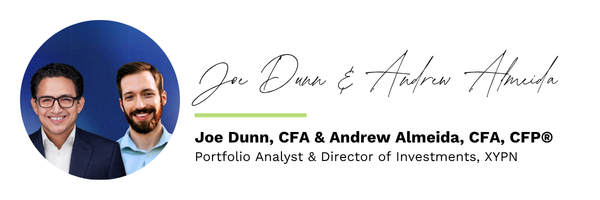
Joe Dunn
XYPN

Andrew Almeida
XYPN
If we put a 4% bond and a 6% bond in front of you, which one would you choose? The 6% yield may look more attractive at first, but why are you being paid more?
That question is at the center of this episode of Balanced PM. We break down the anatomy of a bond yield and examine the risks that underlie that single number, from the risk-free rate to credit and term premiums. Our goal isn’t to make fixed income more complicated. It’s to better understand what the market is telling us and how investors are being compensated.
We also bring that framework into the current market environment, where yields remain elevated, credit spreads are tight, and expectations around inflation and interest rates continue to evolve. Rather than trying to predict exactly where rates go next, we discuss how we’re evaluating the risks available today and where we believe investors should be asking more questions.
For us, that’s the bigger portfolio management conversation. The goal isn’t to find the highest yield. It’s to understand the risks contributing to that yield, decide which ones are worth taking, and determine whether the compensation makes sense for the client.
Listen to the Full Interview:
Watch the Full Interview:
What You'll Learn from This Episode:
- Why a higher yield doesn’t automatically mean a better investment
- What makes up a bond yield, including the risk-free rate, credit premium, and term premium
- How inflation, interest rates, economic conditions, and credit risk can influence yields
- Why understanding the risk behind a yield matters when evaluating fixed income opportunities
- How today’s elevated yields and tight credit spreads are shaping portfolio decisions
- How to think about fixed income through the lens of each client’s goals, time horizon, and risk tolerance
Featured on the Show:
- Andrew Almeida, CFA, CFP® | LinkedIn
- Joe Dunn, CFA | LinkedIn
- Introducing Balanced PM Blog
- Ep 1 | Breaking Down Stagflation
- Ep 2 | Navigating Uncertainty
- Ep 3 | “Do I own SPCX?!” - Active Decisions Hiding in Passive Investments
This Episode Is Sponsored By:

Read the Transcript Below:
Joe: Welcome to episode four of Balance PM, where we prioritize context over conviction to help you make better portfolio management decisions. We're your hosts, Joe Dunn and Andrew Almeida, coming to you from XYPN Sapphire. But before we get into it, let's get that CYA out of the way. This podcast is produced by XYPN Sapphire, an SEC-registered investment advisor that is wholly owned by XY Planning Network.
We're part of the same XYPN family, so we may make references to the larger network. This content is intended for educational purposes and should not be construed as investment advice.
All right, Andrew, it's good to be here with you for episode four of Balance PM, and I'm looking forward to today's topic. It's not necessarily the most exciting topic, I'm sure, by a lot of people's standards, but I'm excited 'cause, I got my start in the industry, or at least the research side of things, as an individual bond analyst, and I think it's just people really discount the importance of the bond market and understanding the underlying dynamics that go into it.
So I'm excited to kinda peel back those layers a little bit and share some of the, the basic but still very important details that people should consider
Andrew: Yeah, I think most people, not most, but a lot of investors think of bonds as the boring side of the market. I too really kicked off and cut my career in the bond market. I spent a handful of years on a muni desk, not nearly as much time as you spent in bonds, but I think between both of our experience, we should have a fun conversation today
Joe: And it really is true that debt makes the world go around. People like paying attention to stocks, but it's the bonds that really do the heavy lifting throughout the economy. But to kinda tee this whole conversation up, just why are we talking about yields? Because it's not just us. We're obviously paying attention to what conversations are coming up more commonly across the industry, what our advisors are asking about, what their clients are asking about, and yields are on people's minds these days, and for pretty good reason.
We're coming into this conversation seeing the 30-year U.S. Treasury yield that is at high levels that we haven't seen since around 2007, and we're 30 years around, what? 5.2% right now. 10-year yields, it's ina similar position right now, highs that we haven't seen since around the 2000 era-- the 2007 era and 10-year is at about 4.7%.
So overall, rates are definitely elevated from what we're used to seeing in recent years, so that's a big part of the conversation. But people are also paying attention to what's happening on the Fed side of things and what they're gonna do with their interest rate policy. And a really interesting wrinkle in that whole puzzle is that we came into 2026 with markets pricing expectations for rate cuts before the end of the year, but obviously economic conditions have evolved quite a bit since then, and now we're sitting at a point where markets are actually implying expectations for rate increases before the end of the year.
So needless to say, the bond market is certainly keeping us on our toes these days and I think that there's some real value that can really come from understanding some of the basics that underpin the headlines that we're seeing today in the yield space.
Andrew: Yeah, it's, it is interesting when rates start to get more volatile, and I've heard the debates between bond guys and equity guys about which is a better indicator or forward-looking indicator of the market. Honestly, myself, I'm a little bit more biased towards the bond market as being a better indicator.
And I think when you start to see interest rate volatility in bonds, you shouldn't be too surprised by seeing the interest rate volatility to proceed in equities to follow that. And we've seen more rate volatility in bonds in recent years than we had over the last number of years. I know, we touched on how we got started in the early parts of my career, which began in late '07, '08 after rates dropped particularly low.
A number of years followed where the conversation was like, "When are rates gonna rise? What do I do in a rising rate environment?" But that was off of, nearly 0% interest rates. Now, are we potentially looking at a rising rate environment off of a higher base case? It's an interesting, it's an interesting thought experiment to go through and I think investors being more uncertain about what direction rates might go at this point is also interesting.
So there are a little bit more variables to discuss. I know we'll get a lot into the components of yield. It's not linear in terms of what makes up risk. There's a lot of things that go into building a bond yield and and I know you spent a lot of that in your research time, Joe. So tell us tell us some stories or some of the war stories you've gone through.
Joe: I think a big part of the conversation is just kinda clients' natural tendency to maybe seek out some of the higher yields if they're not really well-versed in the bond space, they're not paying attention to what yields do over a long period of time. They see oh, a 7% yield on a bond that's being offered, like that sounds pretty good.
If I could, historically get around what? 7% to 10% average for stocks is what a lot of people reference. So oh, I see a 7% yield in a fixed income security. I should probably go to that, go into that. But obviously that, that casts aside all of the different components of the risk that builds up to that 7% yield, 'cause as I said at the beginning, no one's gonna give you a free lunch.
You don't just get a better return for no reason at all, and it's tempting to see a fixed income security and they're like, "Oh like it's fixed income. I know the return I'm gonna get on this bond so I'm inclined to go after that higher yield." But that's really not the, the thought process you wanna have when going to fixed income.
You wanna have a really thorough understanding of what is contributing to that risk. And I can't tell you the, the countless emails I've gotten in the past where an advisor will forward along an email that a client got directly to their own inbox and says, "Oh, here's a 7% or a 9% bond offering and it sounds pretty good.
Is it too good to be true?" And I think generally if you have to ask yourself, "Is this too good to be true?" Especially in the investing space, the answer is probably yes. And I would always love seeing how quickly I could click the link that they sent me and just run down the list of red flags that I pick up on, whether it's the length of time that this issuing company has been around.
Oh they literally just started business within the last two years, so they don't have any track record. Or just looking at the language that they use in terms of how confident or if they're getting close to the terminology of guaranteeing their returns and things are looking a little fishy.
Or even what's the nature of their business? A lot of them that I looked at were like debt consolidation companies, which they market it in a really good way. They're like, "Oh, we find these clients who have a lot of outstanding debt, and we package it up for them and give them a better interest payment that they can actually make sustainably."
And at face value, that sounds great, but when you actually look at the underlying mechanisms of the business, you're seeing, oh they're debt consolidators that they... Or they... Debt collectors that buy debt for pennies on the dollar, but then force the original, lendees to repay the full balance of their debt.
So that'sa very specific situation, but just kinda anecdotally want to paint a picture of yeah, if you see a yield that seems too good to be true, that it often is too good be- to be true. And we're hoping to use this episode to talk about what advisors and their clients should really be paying attention to when they look at that yields number
Andrew: Yeah. Not every yield is built the same, not every bond is built the same, and it's very easy for investors and sometimes even advisors to look at what the highest yielding bond offering might be or a bond-yielding ETF product and say, "I'm gonna go with this one." If there'sa quick takeaway, it's, don't go into your trading software, sort by yields, pick the highest one and think that, oh, this is safer than equities.
It very well may not be, as you allude to with some of the examples you've seen. So there's a lot to speak about, but before we even get there, Joe, could you like tell us, and for those of, in the audience that aren't familiar with just bond basics, like what is a coupon? What is the yield? How does price affect these things?
Like just the quick and dirty.
Joe: Yeah, absolutely. Yeah, there is some confusion that comes up around what is the difference between yield and a coupon rate? So just kinda lay it out in most basic terms I can think of. Say you have a bond and its par value is $1,000. That's like the, the principal amount of the loan. And on, on top of the, the principal amount, then we havea coupon rate.
So say we have a $1,000 bond and it has a 5% coupon. If an investor were to purchase that bond at par, meaning at that $1,000 value, their yield would be the same as that coupon. Par- purchased it at par, yield is the same as that coupon rate, 5% in this example. But as we know, the prices of bonds do not stay fixed at par.
They're constantly changing in value. They're going up, they're going down, and that changes the composition of the yield. If we havea bond that was in- init- that has $1,000 par value, but it's trading at $900 obviously that's a big discount, but investor buys that bond for $900, their yield is now the 5% coupon that's baked into the structure of the bond on top of the pull to par that they get.
So they bought it at 900, but it's going to mature and they're gonna receive $1,000 at maturity, so that additional $100 on top of the interest payments that they get from the regular coupon payments, that's the whole composition of the yield. So if you have a bond that's trading below par, the yield is gonna be higher than the coupon rate.
And if you have a bond that is trading above par, then it goes in the opposite direction. You have to pay more than the principal you're gonna get at maturity, and that's gonna bring your yield down. And that also speaks to you might hear a common reference to the inverse relationship between bond prices and bond yields, so it just speaks to that, that whole composition of the yield.
And as the price goes up, then yield goes down because you have to pay more for that same coupon payment and principal to be returned, so your overall yield is gonna be less. And vice versa, again, inverse relationship. If the price of a bond goes down and you can buy it for less, then your yield goes up 'cause the other components are fixed in place and you just, you paid less for that, that cash flow.
So yeah, it is really important to make that separation between coupon and yields because they are quite different. And for this whole conversation, we're gonna be talking about yields, which is the combination
Andrew: Yeah the math, I think if you've been in this industry like we have, or you spent some time in bonds and you are a little bit math inclined, it's some of that certainty that comes in just the pricing mechanics that gives us some enjoyment about a little bit more visibility into what's happening with prices.
Because as we get into the components of risk, which I know you'll start, you'll go into, then your yield is affected based on those components. And it's not a linear relationship, but you could draw the relationships of kind of the risks associated with the bond and the yield you're going to achieve.
It's a lot more clear than you might get, say, in the equity markets, which could be a lot more ambiguous.
Joe: Right
Andrew: I would add one more component in terms of the yield coupon, discount or premium, and then also assumption of reinvestment at the same rate, which is That is the one ambiguous part because it's assuming you invest the coupon back at the same rate every time, and that...
Joe: rarely happens in practice, at least to the T.
Andrew: Exactly
Joe: Yeah, definitely agree with that. And I think even more important than understanding kinda just the, that composition of yield there's another underlying composition of yield, and that's gonna be real crux of today's conversation is, all right we talked about from a structural standpoint, the component of yields is the combination of the interest payments and the pull to par.
But in terms of the, from a risk standpoint, I think it's also really important to understand the composition of yields, and we can really break it down into three pretty clean parts. So we have the risk-free rate, the credit premium, and the term premium. And we're gonna get into each of those in much more detail, but just to give everyone a kind ofa high level view of those.
In risk-free rate, those are set by the U.S. Treasury market, and it pretty much is taken as a representation of what rates should be minus the addition of credit risk. So w- we're saying the U.S. government isa riskless a riskless issuer, which again, we'll get into that in more detail, and that is kinda the, the kernel that yields are built upon.
Then on top of that, you can add a credit premium. So that's for any issuers that are not the risk-free issuer. They have some degree of default risk, uncertainty around how much they're gonna actually be able to pay back within this debt obligation. So that's the credit premium that you stack on top of the risk-free rate.
And then you also have the term premium, which is you should get paid a little bit more for putting your money away for a longer period of time. There's inherent risk that comes with locking your money away for a longer period of time, so there should be more yields for the longer term of that obligation.
So you take those three components together, risk-free rate, credit premium, and the term premium, and those three things stack together and form our complete yield picture. And yeah, we are going to, again, get into the details of those, but really just wanna hammer home the idea that you should not think of yield as just like an individual measure of risk.
You can't just look at the, the yield as a single number and say, "Oh, I know how much risk that represents," because it's an aggregate of a bunch of underlying risks and that's what we're gonna dive into. And with that, let's start with the first of those three components, which is the risk-free rate. And US Treasury yields are often referred to as the risk-free rates. More specifically, commonly cited is the three-month Treasury bill and the 10-month Treasury bond. Those are the most commonly cited risk-free rates.
And before we get any further, I kinda wanna get your thoughts, Andrew, on the name itself, risk-free rate, just the concept of a risk-free rate, 'cause it's a bit of a misnomer, no?
Andrew: Yeah. You probably know by now how I feel about naming conventions and misconceptions. I'm not always a fan of them. But and you brought up one earlier, too, which was free lunch. Anyone who's taken a Finance 101 class knows that one of the first things they hear in this industry is that there is no free lunch.
That translates to everything comes with risk. The risk-free rate, it's not entirely riskless, but for our audience, why is it called the risk-free rate? We say that the only thing you can guarantee, or you shouldn't make guarantees, but the one guarantee that is accepted in our industry is that the U.S.government is going to pay its obligations. And that is why we use and benchmark the U.S. Treasury as the risk-free rate, and that it is the lowest, generally, yield you can receive becomes, it comes with almost no risk. And why do we say no risk? Because the U.S. government can continue to print dollars to pay back the debt obligations.
And I'm gonna caveat that with, so long as it remains the world's global reserve currency, it can do this in a way where we don't suffer hyperinflation like another country who might just print money and nobody wants their currency. Is it without risk? No. Is it the most riskless asset in the globe today?
Yes. We call it the risk-free rate because benchmarking of all returns and all rates proceed, proceeds after that. There are still risks present, the U.S. credit, monetary policy effectiveness, the total issuance of Treasuries, debt and tax receipts, and then ultimately the acceptance of the U.S.
dollar as a global reserve currency. It's as risk-free as you can get
Joe: And to your point of like you can mention, mentioning the acceptance of the US dollar as the world reserve currency, and that's the piece that I get hung up on because it seems like one of those things where, and we're about to dive into some of the, the mounting risks that we could see as potential concerns.
But the thing, the reason or the fact that it is held up by the public's acceptance of that makes it seem like it could be something that could change on a dime too. Very sentiment driven. And we've seen a lot of cracks I'd say in recent history in terms of the world's role in the global economy, and people are starting to rethink things.
And like I'm not worried that's going away anytime soon. I think we're still relatively assured that the US dollar is gonna continue operating as the world reserve currency, and the world doesn't really have any other options right now. But that doesn't mean that it's not one of those things that it works until it doesn't, and then right when it stops, it's not gonna be a gradual process from there.
It could be a rude awakening for sure.
Andrew: Yeah, I think, and just to chime in there, like you mentioned like the sentiment of it and the acceptance. The technical term people always use is the full faith and credit. Credit is your ability to pay your obligations, but the full faith is the trust in the system, in our laws, in our policies, in the way we accept open trade and business practices.
So that's the full faith part and the acceptance of the system
Joe: But speaking to the underlying risks that could potentially challenge that status quo, a big one that comes to mind is just the level of debt that the US has right now. If we're looking at US debt compared to our GDP, we're at over 120 right now for the ratio. So that's saying that for every unit of GDP, we have 1.2 times the amount of debt.
So we have more debt than income that we're generating every year, and that'sa pretty scary symptom, at least if we look at it in a historical context. If we go back further in time, between 1965 and 1985, that ratio was below 40, which is, so one third of where we're at right now. If we're looking in the the '90s and the 2000s, it was closer to 60% of GDP is the level of debt that the US was carrying.
And ever since the 2008 global financial crisis it eased its way up to 100 perc- 100% in the five years following that. So we got to a point where we were like, "All right, for-- we have the same amount of debt as we do annual GDP," but we have blown past that recently. It did plateau for a little bit, but ever since COVID, it exploded after the fact.
We had to issue a lot more debt in the era of COVID, and now we stand at over 100%, 120% debt to GDP. And credit agencies are starting to notice. Moody's is the most recent downgrade, I believe, in 2025. But all three major credit rating agencies, Moody's, S&P, and Fitch have taken away the coveted AAA rating of US debt.
So not to say that's the, the end-all be-all by any means, but if I'm thinking of it in the context of my personal finances, if I went to a bank and tried to get a loan, yeah if it was in the, the '60s, '70s, and '80s where I ha- I was requesting debt of 40% relative to my personal GDP, then yeah, that would be fine.
But if I were to go to a bank these days and say, "Hey, I need to take up more debt," and my total amount of debt is 120% of of my GDP, then that would certainly raise some red flags on a personal loan perspective. So it's just a matter of are people gonna start catching on at the, the national level?
Or is this just gonna be something that keeps marching forward with- without anybody really questioning it too much?
Andrew: Yeah and depending on what metrics you're looking at and what timeframes, debt service, the interest payments we pay is now the second largest expense in the budget or third, right? Depending on what timeframe you're looking at and what metric. But it's not without consequence, and the ratings agencies have n- obviously taken notice of how that's built up over the last decade.
But long story short, this term risk-free is not... There still is no free lunch. It's not without risk, and it's a little bit more semantics than truth
Joe: Absolutely. But all that aside, we could have a whole multiple-hour conversation about the fiscal sustainability of the US debt situation. But for the purpose of this conversation, we will cast that aside, and if we consider US debt default risk-free, then a reasonable person might ask, "All right why do the yields on US Treasury bonds constantly change if you know the income you're getting?"
So you know there's a fixed coupon payment barring conversation around variable rate debt but for the purpose of this, fixed rate. So all right, the-- we're considering it risk-free, so the level of risk someone might think isn't changing. Why is the yield changing if that is supposedly a measure of risk?
And I think that'sa pretty fair line of questioning with fixed rate debt. Barring any credit event, you know how many dollars you will get in return for entering into this obligation. But that's at a nominal sense. You know how many dollars you're gonna get, but you don't know what those dollars are going to be worth.
The value of those dollars are constantly changing, and as we know from recent history, $1 can buy less and less over time when inflation im- is present, so it makes sense that changing inflation expectations could change yields as well. And there, there is risk in that dollar promise to you in the future because y- the risk is I don't know what it'll be worth.
I know, all right, I know I'm gonna get that dollar in the future, but what am I gonna be able to do with that? And it really does go beyond inflation. Inflation is the most glaring example because it, it's-- people can directly connect it to a deterioration in their purchasing power. But I'm hoping, Andrew, you can walk us through some of the other macro factors that influence how risk, the risk-free component of yields is constantly changing.
Andrew: Yeah, if you bring up inflation, that's a big one. As inflation goes up, nominal rates go up, and it's not just macro influences inf- influence inflation, and inflation influences rates. So it's kind of a build-up effect there. And what are some of these more fundamental things?
First of all, we're not operating in a silo. There are alternative assets which investors can go to. So the supply and demand on any given day is going to affect prices on US Treasuries versus J- Japanese bonds or European bonds, right? So those trade-offs are considered every day.
The amount of money in the market, the demand for these assets, and the supply of these assets, how much debt these countries need, is constantly changing, and investors aren't only operating here in the United States looking at United States bonds. They're considering these trade-offs. Those trade-offs and some of those decisions are predominantly driven by what?
Economic growth. How do we see the outlook for this company doing? How are wages growing? How are job opportunities growing? How is the population growing, right? Just population alone is one of the biggest impacts of economic growth at least historically. We'll see what AI has to do with that.
But as you had more people spending and more people earning, GDPs were growing. Those more fundamental things like labor and population and productivity, how much is being produced by individual unit labor input, right? How much... I might spend an eight hours working and get a lot more done and someone might spend eight hours working and get less work done.
So those are the very fundamental things that drive economic growth and development impact inflation, and impact rates. Some of those I would put them at, maybe in two categories, the trade-offs of investors spending money and then the actual economic capital that goes into economic development in the system.
Joe: Yeah, and you referenced this, but I think it's important to point out that, I started talking about inflation and you got into economic growth. We talked about the labor market and all that, and originally I was framing it as these different macro influences, but they're not really different macro influences.
They're just, as you said, more fundamental, where inflation is a lot of times the statistic that people will reference in this context, but it's really the inflation is just a symptom of these underlying drivers, and I think that's a really important component to dissect. And y- you mentioned kind of the, the buying and selling and how that can impact bond yields, and I think we'd be-- we, we'd be amiss if we did not reference the s- one of the largest buyers and sellers of fixed income securities out there, and that's the Federal Reserve and the impact that Fed policy has on bond yields, whether that's them actually setting their preferred interest rate with the Fed funds rate, or they're also taking part in open market operations where they're buying bonds or selling bonds to build up or draw down their balance sheet.
And as we talked about with the components of yield and how price is a piece of that if somebody's buying bonds, then that's going to drive the price up naturally as we see, and that's gonna bring yields down and vice versa. So the Fed has not only interest rates as a tool at their disposal, but they can also buy and sell bonds to help influence rates on the longer end of the curve.
Andrew: Yeah. And if that's not enough, that just goes into the risk-free rate, all these geopolitical factors. What happens when we have other issuers outside of the US government that aren't considered risk-free, Joe? Take us into credit. What happens there?
Joe: Yes, you're absolutely right about that, and that brings us to the credit risk premium, which is the second building block of overall yield that we're gonna talk about. And I wanna start off with a little bit of an example. So say you have a February 2031 US Treasury, and that's yielding 4.33%. And say you have a similar February 2031 bond that was issued by Intel, and that bond is yielding 4.85%.
So we took out the term risk part of it because we found bonds that were at very similar maturities, but yet the Intel bond is giving you an extra half a percent in yield. And why? Why is that? And that's the credit risk. It's the perceived lower likelihood that Intel will give you all of your principal and interest relative to that same perceived likelihood of the US returning all of your principal and interest at the end of that, that loan agreement, the bond.
And that perceived risk is what gives you additional yield. The investor demands a little bit more return for lending money to Intel because they see them as slightly less likely to get all their money back from them. And that comes from a range of things. It comes down to the strength of the company's balance sheet, their cash flows, how much leverage the company already has and just other company specific details and overall sentiment that feed into that credit risk premium that is demanded for individual corporate bonds or just non-US Treasury issuers.
And luckily we have credit rating agencies that can help us kinda sift through a lot of that information, because I don't know about you, but I don't have time to sift through the underlying fundamentals of all of these companies and decide what a bond should be or how I should view a bond's risk relative to a bunch of other issuers.
And these credit rating agencies take out a lot of that legwork for you, and they try to standardize it, and they have credit rating structures, different grades that they assign to different companies based on the credit rating agency's perception of that issuer's risk. And I think it's important to really mention while the credit rating agencies and the ratings that they put out there are incredibly helpful tools, I would argue it's the best tool that most retail investors and non-institutional investors have for assessing the relative risk of fixed income securities.
That's not to say that they're not without their faults. Some people often question the reliability of these rating agencies. I don't know if Enron rings a bell to anybody, if that name sounds familiar, but that on top of a bunch of like subprime mortgage lenders pre-2008. A lot of these rating agencies had-- were sticking to their guns with these very favorable ratings for all these companies.
And they were certainly behind the ball and, Obviously in the case of Enron and subprime mortgage lenders, we saw that turns out they were a lot riskier than these credit rating agencies might have made you think. Definitely something that you wanna take with a grain of salt, but a valuable tool nonetheless
Andrew: Yeah the rating agencies, given some of their history, aren't my favorite. Coming into the industry in '08, I, I definitely have more pessimistic view of what their reliability is. And
Joe: impression wasn't good,
Andrew: no, yeah, very bad first impression, and I'm not gonna get into the depths of what a mortgage bond was and how it was structured, but in short you had a ton of subprime, meaning, below quality lend- borrowers buying houses that couldn't afford them.
And because the bonds were structured in a way that diversified over thousands, tens of thousands of bad borrowers, the credit agencies slapped a, double A, triple A rating on these bonds, but that didn't change the fundamental nature of the borrower's ability not to pay. The ratings agencies, who by the way are collecting fees from the bond issuers v- very much showed their bias in getting business done over pricing or evaluating these bonds correctly.
So I always look at the ratings agencies as a bit of a bias, the same si- same way a sell side equity analyst might have some bias.
Joe: Yeah. But circling back to just the fact that with-- for all their faults, we have to be cognizant of those, of course, but they are relatively reliable sources or at least helpful sources of credit rating. Get a sense of, all right, how risky is one bond versus the other? I feel like the credit rating agencies are kinda like meteorologists where yeah they get a lot of their easy daily weather reports correct, and people don't bat an eye.
They're like, "Yeah that's what they're supposed to do." And then as soon as they say it's gonna be sunny and it actually rains, people are in an uproar and they they get mad at those meteorologists. It's a tough spot to be in, but hey, that's the business you chose. But I think it's also important to talk about another layer of credit credit risk premium because it's not all based on these individual issuers' details.
There's also a concept called credit spreads where we kinda think of a bunch of these debt issuers and bucket them together based on their perceived risk. For the credit rating agencies S&P as an example, they have AAA, AA+, AA, AA-, BBB pl- or A+,and so on anda tiered structure where they say, "All right, you're getting riskier and riskier as you go down that ladder."
And for each issuer that finds themself at one of those rungs of the ladder, say, all right, you're iss- you're an issuer that's rated BBB, there's a bunch of other debt out there that's also rated BBB, and those buckets tend to move together based off of macro trends that are happening that are really not any fault of these individual issuers.
They're just kinda caught up in it and it's tied to the risk-free rate, but it's also, there's a higher degree of sensitivity to those macro changes as you get further down in credit quality, so they tend to kinda move together and ebb and flow. You might have some negative economic news and the, the AAA issuers don't move that much.
Maybe the AA issuers move a little bit more and their yields go up because their perceived credit risk is slightly higher, so they're gonna be more sensitive to this negative economic news, and so on and so forth. As you get down to A and BBB and BB, as you get further out on that credit spectrum, they become more sensitive to the underlying economic changes.
So yes, there isan idiosyncratic component where the individual issuers' decisions make a difference, what their revenue, net income, all that looks like, but there's also just a market aspect in the fact that the bond market largely moves together. It's not they don't necessarily move in tandem.
I kinda picture what's it called when birds murmurate? Is that the word, murmurate? Murmuration? It sounds weird now that I'm
Andrew: but it could be
Joe: those like big groups of birds that like they, they mostly move together, but there's like a little variation in how they move, and that's kinda how I picture credit spreads changing is the individual bonds move slightly different from one another, but there's still these larger groups that you can kinda see moving in a similar pattern.
And so yeah, for credit risk standpoint, it's not just the individual issuer's decision, it's how does that level of credit worthiness as a whole across the market, how is that impacted by the underlying macro changes?
Andrew: Yeah, and let me say this in another way for our advisors and allocators who might be listening, because spread risk is very important and often under anticipated and under- misunderstood. You don't see a ton of high-yield allocations in portfolios today because spreads are so tight, right? That is the additional compensation you're getting compared to more investment-grade bonds isn't a lot more.
Now, you could look at that in two ways. It could be a signaling that, hey, credit qualities are much better than historically or remain to be seen to be good in the years to come. Or you could see that there is an opportunity, or not an opportunity, there is a possibility that spread risk could very much hurt you in the future.
Now, what would that mean? That would mean that if spreads on high yields, let's say be- get perceived to be more risky, that is the credit risk gets to be perceived more risky than the current status, you could have that one flock of birds staying in one area, the investment-grade bonds, but the high-yield bonds start to tail off and fly in another direction, and that would be a pricing movement.
That is the price come d- price comes down, yields go up, thus the spread between high yield and investment grade gets wider. That's the spread. And if that spread gets wider or you have an increase in spread versus investment-grade bonds in high yield, then it's going to hurt your price return.
And if you're not holding those... If those bonds aren't money good to maturity or you are a high-yield bond fund holder, you will see the price impact of your holdings go down drastically in a situation where spreads blow out or the birds fly away, as you so eloquently put it, Joe.
Joe: Yeah, and it's not always fair. Sometimes the baby will get thrown out with the bathwater, and it's just a matter of, all right, my bonds just became a lot cheaper and have higher yields just because general sentiment with our level of credit ratings, and that's just the nature of the bond market and how it all moves And that brings us to the third building block of this premium, which is the term risk premium the additional compensation that you get for tying your money up for a longer period of time. And I want to start off with just a hypothetical personal example. And if I know, Andrew, if I were to ask you right now, "Hey, can I borrow $100 and I'll give it back to you next week?"
What would you say?
Andrew: Sure, Joe. I know how you're employed and what you're making, so I trust you.
Joe: What a guy. I m- I might circle back to that. But all right, what if I were to update that and say, "Andrew can I borrow $100 and I will give it back to you in 30 years?" What would you say?
Andrew: What you're gonna be doing in a couple of years, Don? You're a risky kinda guy
Joe: Yeah. So same amount of money that I asked to borrow, but completely different time horizon that we're looking after and and at least from what you were saying, it seemed like you perceived a different level of risk between those two requests.
Andrew: Yeah, for sure. It's definitely not the same
Joe: Nice. And so with that in mind, Andrew, just walk us through in a more holistic sense, especially in the context of the sp- actual bond market, like why does term risk premium exist? Why do investors demand higher compensation for longer-dated debt?
Andrew: Yeah. Two reasons. One is directly associated with kind of the example you gave. With a company though, if you're borrowing money from a company, there's no saying what decisions management might make, how management might change, or how the core business might change one, three, five, 10 years from now.
So you want to be compensated for holding the debt longer. The other is, and this kinda goes back to where we started the conversation, the trade-offs in markets. I could buy one-year debt from Joe or, and then after that matures, buy one-year debt again from Joe or buy one-year debt again from Jane. And in a corporate sense, I can compound returns of those one-year terms consecutively with less uncertainty and compound my return over that period.
So there is the term premium as, if we're getting very specific as to the just the number of years and basic finance and compounding of returns, you need to be compensated equivalently for how those returns would compound year to year which, has a more mathematical geometric compounding effect and the rate would go up
Joe: Yeah, over a longer period of time, you alluded to this, but the issuer's conditions can change, how likely they are to be able to repay their debt, that can change. The investor's conditions can change. They, they're lock, hyp- hypothetically locking their capital up for a longer period of time.
They don't have-- obviously we're outside the context of how liquid public debt markets are. They're locking their money up for a longer period of time, and they're not using that money for anything else. There's a risk that comes with that. But then, yeah, overall market conditions can also change, and that kind of brings us to the conversation around duration.
And duration, long story short, it's the interest rate sensitivity of a bond. It's how sensitive is the price of that bond to changes in the market rate environment. And there's really, there's two pieces to this. We could think about it in a theoretical sense, where it's just like over a longer period of time, there, there's room for things to change.
There's a higher degree of risk just 'cause more things can happen. But it's also very much ti- it ties back into the math component of bonds and that bond returns are very much based in math. And if you have longer dated debt, and we're thinking about it, what's important for someone who's purchasing debt?
It's the, the cash flows that they get from that engagement. And the longer you push your debt out, the longer your cash flows, or the further out your cash flows are. And so say, whether it's inflation expectations, the labor market, whatever economic growth, those conditions are changing, and it's changing the interest rate environment.
And that interest rate environment is dictating how much those future cash flows are going to be worth to you. Then as you get further and out, that math continues to compound, and the sensitivity to those underlying changes becomes more prominent as you get further out in time, and you have to apply that math over a longer period of time to get back to what is this worth to me today?
What is the present value of the, those future cash flows? And yeah, for some of our listeners, it might be more helpful just to focus on the theoretical aspect, but it ties in nicely with the actual math and how that works.
Andrew: Yeah, and I think most of our investors and our advisors are gonna see a duration print on a fact sheet or in a summary of a mutual fund or a ETF description. And correct me if I'm wrong here, but if you have a duration of four, that means a 1% increase, and this is a little simplified, but, a 1% increase in relative rates compared to that maturity would mean a 4% reduction in price, right?
So ballpark. So that's what that number actually, you could translate to. Obviously a duration of eight would mean that a 1% increase in interest rates would mean an 8% reduction in price, twice the risk. There's a very mathematical very easy to draw relationship. You can use duration number as to measure your interest rate sensitivity
Joe: And so far we've been talking about term premium as like a common sense component of yield. We're saying, all right, it's-- you're gonna get more money for l- for locking yourself into arrangement that lasts longer. That's what we're saying. But historically, the term premium has not always been positive. So Andrew, kinda hoping you can talk to us about those environments.
Like wh- when did we see it most recently, and how does that even make sense? Why would anybody ever accept less of a return for locking their money up for a longer period of time? It doesn't really sit well with common sense at first glance.
Andrew: Yeah, we saw it recently in, in the second half of 2004 and, the, the term premium or the yield curve... In 2024, I'm sorry. The yield curve inverted and higher rates on short-term than longer-term bonds. And, typically, and this is a very good ec- economic indicator that this might precede a recession, but I think it's the why that people wanna understand or how does that even make sense?
Because wouldn't we rush to lend or borrow on the short term and lend money to our government? What actually happens is economic activity is really dominated by the lending markets being healthy, and for the lending markets to be healthy, banks need to be able to lend. So it's not really the consumer perspective, it's the bank perspective, and the banks borrow on the short term.
So if rates are higher in the short term and their funding costs, their borrowing costs are higher than what they can lend out to everyone else in the economy, then lending seizes up. The availability of capital freezes, and anyone who's stuck with bad debt has a lot more difficulty to refinance their debts.
While the banks reduce the amount of lending that they do, credit only goes to the highest and quality and best perceived borrowers, and those who need to refinance their debts, even though the nominal rate looks so much lower for 30 years, let's say, and you say, "Oh, wow, everyone should be borrowing at that rate."
No. Banks are sh- are hamstrung to lend at that rate. So the, the thinking gets a little bit inverted. Lending seizes up, availability of capital seizes up, and it becomes very difficult for lower quality borrowers to borrow or to refinance bad debt, and that's why you have a problem.
Joe: And you reference its historical significance as a pretty good indicator of an impending recession asa yields curve inversion. And for the sake of this, we're referring to an inversion between the, the 10-year Treasury and the two-year Treasury. When the two-year Treasury is higher than the 10-year, that's when it's commonly considered an inverted yield curve.
There's other measures that some people use, like the three-month, it might be more preferred. But general sense, if the two-year rate is higher than the 10-year rate, that's an inverted yield curve. Yeah, and you mentioned it has a good track record of predicting recessions, but one key piece is that it's a terrible predictor of the timing of that recession.
So yeah, you referenced that we saw this most recently at the second half of 2024, and at least as far as I'm aware, we're still-- we haven't entered a recession since then. We're waiting for, or people have been waiting for one. It doesn't seem to be materializing just yet, and I think that kind of speaks to the uniqueness of the pandemic's role in the inversion of the yield curve.
It was an unprecedented situation that led to lower or shorter rates being higher than longer term rates. Who knows if the, the pandemic's role in that will also reduce the the efficacy of an, a yields curve inversion as a signal for an impending recession. But again, since the, the timing of that indicator is pretty poor, maybe it's still on the horizon.
Who knows? But I think even more importantly, people are still wondering, like, all right why would a-- you referenced from the, the bank perspective, like, why an inverted yields curve is not a positive indicator, but just from the context of like, why would someone accept a lower rate for longer term debt in an inverted yields curve environment?
Like, why does that make sense sometimes?
Andrew: The market rates prevail as supply and demand dictates, so that availability of capital is certainly a big part of it which goes to the supply side. But with a lower supply than than there is demand, right? There being more purchasing than is actually out there, that's going to drive up prices and yields down on the long end of the curve.
Now, the other is market expectations as well. In this scenario where you're expecting a lower economic growth, then markets participants start to say what happens next?" There's going to be lower economic growth slower maybe rising unemployment, fewer jobs a need for potentially prices to come down and deflation.
The, the seizing of economic activity then says what's going to need to happen next for in the future," right? Your longer-term rates for this to correct, we would have to bring rates down. Because even if funding rates go up on the front side of the curve, right? You could still have longer-dated rates also go up, and that's a different scenario.
That's a scenario where you're expecting more potentially economic growth or the economy is heating up and you have inflation, and you get these parallel shifts up in the yield curve. Shorter rates are going up, so are longer rates going up. And the availability or acceptance of the issuer, in this case let's say the US government, is less accepted and perceived as more risky on the longer term, less demand fewer buyers, more of US debt, more sellers of US debt, therefore prices go down, yields go up.
So it-- the expectations as well as the underlying economic activity that come with it can cause rates to move up in parallel or rates to move up in the short term and down in the long term. And that's the kind of the story that goes with either a parallel shift up or an inverted yield curve.
Joe: Yeah, and I think-- so you touched on a few things and it's kinda hard to discuss sometimes because you're talking about like expectations of future economic conditions and then also the supply and demand, buying and selling, the impact that has on yields. And it's, in, in practice, you can't separate those things because they are connected to each other.
But I think it still helps to separate them from a conceptual standpoint when we're just kinda learning about them. And yeah, part of it is speculation on future conditions, and that's saying, "All right what do I think rates are gonna be in the future, and how much am I willing to pay for a bond right now in order to match my expectations of those future conditions?"
So that's part of it, is just speculation on future conditions, and then that inevitably leads to the, the physical mechanism that you referenced, which is the supply and demand, the buying and the selling, and how selling a bond will naturally drive selling any asset will drive the price down, and in this case, it'll drive the yields up and vice versa.
If we're in a thinking just from a sentiment level, if you have, if you're fearful and you experience a flight to safety, that leads to more bond buying. People tend to buy bonds when there's periods of economic distress coming up, and that's gonna force bond prices up and yields are gonna go down.
And vice versa, if it's a risk-on environment where people are like, "Why do I need bonds in my portfolio?" Then that's gonna lead to more bond selling overall and prices are gonna go down and yields are gonna go up in a risk-on environment. And again, it's also just a natural mechanism where, again, risk-on environment, that selling leads to yields going up because those bonds have to compete for capital in the c- in an environment where risk-on equities are expected to perform well moving forward.
So yields, it's just likea natural,a normalization of pressure, if you will to make sure that all this capital can exist in the same environment based on the upcoming conditions. But I think that kinda tails nicely into the next segment of our conversation where we're talking about the physical trading mechanism that contributes to changes in yields, and that's tied into global asset allocation decisions.
Are people deciding to increase their exposure to bonds or are they deciding to decrease their exposure to bonds? What impact does that shift from an allocation perspective have on on the yield environment and also vice versa? How do we look at the current yield environment and use that to, to kinda glean some information as to how we should position our portfolios?
I think that's a, the part of the conversation a lot of people are interested in.
Cause we just went through the building blocks of yield from a more abstract perspective and educational standpoint, but how do we actually apply this framework to what we're seeing today and how we're making asset allocation decisions in the current environments?
And so we're just gonna kinda go back through those building blocks of yields, but talk about it in current context. So Andrew, let's start with the risk-free component of yield and the macro expectations that have a real influence on that risk-free component. Obviously, inflation, that's been a hot topic for I don't know how long at this point.
And we could talk about the labor market, economic activity, the fiscal trajectory of the United States. All of that is part of the story, and all of it deserves attention. But out of all those things, which component do you think currently deserves the most attention?
Andrew: Yeah. Keyword currently, 'cause none is more important than the other, and the one in today's market that I think has got everyone a little bit the most tripped up or is making decision-making a bit tougher is inflation. We discussed this a bit earlier, like inflation is a nominal component of nominal yields.
So you might see yield on the two-year at, 4.25%, and you think, "Wow, this is a two-year investment. I'm gonna get 4%, 4.25%. Why not just do that?" Those were great returns five years ago, and es- and really great returns 10 years ago. I would've loved 4%. But is that 4% sufficient in the current, under current market conditions?
If inflation is, 3.5% then your return over inflation isn't really getting you much of anything. So it's a catch-22 investors are finding themselves in today. Do they take the higher yields, or do they go with the thinking of that the best tool of beating inflation is being invested in equities?
Then you're followed with another question and equities are the best tool for that because companies have pricing power. They can increase... As inflation costs go up, they can increase prices, protect margins, and compound returns at, higher rates or have more control of how to compound returns in their businesses.
The, the other side of that, though, is am I actually being compensated for the current risk of the equity market? That is, inflation's 375. I can get 4.25 on a two-year, but my equity asset has no maturity. It's a perpetual duration instrument. That means it's very sensitive to in price movements on a day-to-day basis in general, and there's a lot more risk there.
How much risk is it, and am I being compensated for s- for it? If I'm only gonna get 6% on that equity, probably not. If I'm gonna get 10%, maybe. If I'm gonna get 15%, right? It all depends on how risky you perceive that company, and that's what makes equity investing so fun, right? It's like you don't know what return you're going to get.
You're making a lot of assumptions to, based on how you think the company's gonna perform and their risk to achieve some amount of return that you are willing to I don't wanna say gamble on, but yeah, take a risk on. That's what's happening here compared to what you can get from the U.S.
government in the market. So once perception changes, that's often when you see these market corrections because the price that investors are willing to pay, they don't think there's enough return to still compound relative to what they can get for less risk, and then they sell equities.
Joe: And I guess, so yeah, you were referencing-- So real yields is the really important part. Nominal yields, that's one thing, that's what people pay attention to, but after impact of inflation, we get the real yield, and that's what's really driving your real economic return as a fixed income investor.
So I guess with inflation being your primary focus right now, how are you looking at the current status of inflation and what, what developments would you be keeping an eye out for, and how would that inform taking the other forms of risk, credit, and term out of the equation right now, if we're looking just at the impact of inflation on how you're viewing fixed income investments and yields right now?
What are your thoughts on that?
Andrew: Yeah, obviously all of this boils down to who the investor is, how close they are to retirement, how much their bond holdings are held for a need of simply comparing the nominal returns between equity and fixed income, which is very much just a very small silo of this assessment, versus the client assessment of understanding how much is the need for capital preservation.
Because if you are, an investor who's entered retirement, you have the nest egg that you need and the income even on nominal terms can support you through retirement maybe you're okay with accepting those nominal yields and not much real return. But if you're a long-term investor who has a much longer time horizon and you think that just...
A- and you're just speculating that there isn't enough risk premium in equity markets, you're taking a pretty... And you're gonna hold, 4, 4.2% or, 5% 30-year Treasuries nominal and you think you're, that's the better return relative to equities over a 30-year period it's a different equation and more likely than not, you're not gonna compound the returns to build up to the nest egg that affect, that beats inflation which means what?
That, over that period your costs and your very y- the real living financial wherewithal of your day-to-day is going to get more expensive at a similar rate of returns as your portfolio, and if you do that until you retire over 30 years, you've gotten nowhere. So i- I don't wanna take the client out of this and just look at it as an equity versus fixed income.
It very m- the timing component is very real to an investor perspective, and that's a little bit more important.
Joe: Yeah, absolutely. Yeah, we don't have general thoughts on asset allocation needs because, yeah, it's very tailored to the individual situation. But let's move on to credit conditions. So the credit risk premium portion of the composition of yields, and I think right now where we're looking at credit conditions, most corporations, they have pretty strong balance sheets and fundamentals from a historical perspective, and they're in pretty good shape right now.
But we're also seeing maybe that starting... is that tune starting to change a little bit? If we're looking at big tech and the hyperscalers, they're obviously dominating the headlines these days, and they're starting to use a lot of their cash. They've been sitting on unprecedented levels of cash, which had people feeling really good about their debt.
But obviously the floodgates have opened recently with the hyperscaler spending on AI and tech build-out. And so they're-- we're starting to see their credit spreads are increasing a little bit. So the, the amount that investors are demanding in additional return for this perceived risk that's coming from, all right, these companies had cash, they still have good cash positions, but now they're starting to dwindle them down and actually use that cash.
So that's getting a little bit riskier. And just as an example, looking at Alphabet, one of the hyperscalers, they had 30-year debt that they issued that was trading at a spread of about 70 basis points or 0.7% above the corresponding Treasury yields back in June. And now Al-Alphabet's 30-year debt is closer to 100 basis points or a full percent spread above Treasury debt.
So that's a relatively minor move, but it's still directionally it tells us a lot, says, all right, these companies are starting to get a little bit riskier from a credit perspective, and bond prices and yields should reflect that. And that's also in the context of I'm saying there's a little bit of spread widening right now, but it's still pretty minimal.
We're still sitting near historic lows for both investment grade and high yield spreads. So what that's saying is investors are not demanding a huge risk, credit risk premium to go down that credit spectrum and take on riskier debt. They say, "Oh, even the junkier stuff, that's looking pretty good these days."
Obviously they still do demand more yields, but in a historical perspective, we're near historic lows, so that's a huge piece of the puzzle. And in my opinion, that kind of, There's a question of when will spreads widen? If we're at historic lows, there's not much room for those spreads to tighten anymore.
They're sitting at those lows. So when and by how much, how quickly are those spreads gonna widen? And even though those are definitely questions that are interesting to think about, I think the answers are real- little irrelevant to me, at least in terms of how we're thinking about asset allocation right now specific to credit, because in my mind it doesn't really matter if or when credit spreads blow out.
and even though we've been talking about the term premium as additional compensation for tying your money up for a longer period of time I do wanna bring it back to the conversation around the sensitivities of those cash flows that are further out, and this comes back to the conversation of duration.
We already talked about it in a kinda theoretical sense, but important to bring this back into what we're seeing today. And when we're setting up the duration conversation, it i-it is a little bit tricky because we s- find ourselves in a heightened rate environment, and this is after years of seeing rates increasing.
And this has been a negative impact on longer-term bonds, 'cause as we said, as you get further out in maturity, those cash flows become more sensitive to the changes in the underlying economy and expectations. So as interest rates are changing, those interest rates have a larger impact on longer-dated debt.
So over the past few years, bonds have not been doing too well because the rate environment has been increasing, and the inverse relationship between interest rates and bond prices has led to bond prices coming down. But that brings me to, all right how are we thinking about that for forward-looking portfolio positioning?
And a lot of people are starting this conversation through a Federal Reserve policy lens. We came into 2026 with markets pricing in expectations for rate cuts, and here we are midway through the year, and markets are now pricing expectations for rate increases. So that has-- people might have positioned themselves and bought longer-term bonds thinking, "Oh, rates are gonna come down," and things changed on a dime and rates went in the opposite direction and ended up hurting them.
And but where we find ourselves now, rates are at an even higher level, so we think, "All right rates could keep going up more," but, like, how much more are they gonna go up? And what's the balance of risks? And a lot of people think, "All right there's more room for rates to come down than there are for rates to go up."
So even if it doesn't happen right away, we could expect rates to come down, and maybe it's time to start taking on some duration risk and really set ourselves up to benefit from that inevitable decrease in the overall rate environments. And but I know that can be dangerous. People might take on that perspective and again, find themselves in a n- situation where rates are going up even more and bonds aren't doing what they expected them to do.
So I wanna get your thoughts on what are your, what's your take on duration in the current environment, and should be, people be eager to take duration risk?
Andrew: Yeah, the Fed might act in one way, and if there's a bias for the Fed to lower rates from this increased environment that we found ourselves in, that's not necessarily connected to certainly what would happen on the long end of the curve for... So you could be walking into a little duration trap if you're looking to take on more duration when there's significant macro activity that could continue to push up rates.
We've inflation being one of them, US debt being another, and now this, potential situation arising with Japan is quite interesting
Joe: Could you elaborate on that a little bit?
Andrew: Yeah. Certainly you have this one piece where Fed on the short term might be di-disconnected from the macro impacts of the long term. And with this Japan situation, you've had Japan coming out of an even longer historical period of lower rates, which has, generated a ton of, it generated more inflation there and weakened the Japanese yen. So to shore up the yen, for them to raise rates, combat inflation, one of the things that they'll need to do is what? Sell dollars or sell US Treasuries from their reserves right? And buy more yen. Now, last week, the US intervened by selling euros to buy yen to help prop up the yen to prevent the selling of US Treasuries. So this is the, where we started the conversation about the trade-offs in markets and the participants. Japan is acting in their self-interest to protect their currency, and if they're going to sell Treasuries to buy yen then they may weaken the dollar and we certainly don't want that to happen.
It... Does that happen if that is happening or sell- the selling of Treasuries, especially longer-dated reserves that would put upward pressure on rates. But it could be a self, fulfilling prophecy for everyone of shooting themselves in the foot because if rates get higher on the long end, economic activity in the US could certainly slow down as just all borrowing slows down across the board, and then you could hit a capitulation point where markets all markets start to correlate in that same direction, which typically is down.
Joe: Absolutely. And for all of our listeners out there, th-there was a lot to take in right there, and to be honest I'm still wrapping my head around what the implications of this whole Japan situation are and all that. But to kinda simplify it to what's the main takeaway there? It's that the Federal Reserve does not determine long-term interest rates.
They have control, they have their hand on the wheel when it comes to short-term rates, and Fed expectations are what a lot of people cite for overall rate expectations, but it really is limited to an impact on the short end of the curve. Long end of the curve, those yields are dictated by macroeconomic conditions, geopolitical considerations like this, and so it's much more complex.
And just to bring it back to the duration conversation, even if you do expect the Fed to lower rates, that's not a telltale sign that long-term rates are gonna come down and favorably benefit and favorably impact longer term bonds. So yeah, the-- even though people might think, "Oh, Fed's gonna lower rates eventually.
Let's load up on duration," well, might not pan out the way you expected if if long-term rates prove to be s- more stubborn than short-term rates. I think it's also important to bring up in the conversation of duration, there is such a big difference to investor outcome depending on the vehicle through which you're investing.
I was an individual bond analyst before coming to XYPN, and so duration, while a consideration, it is not nearly as important if you're looking at individual bonds at the investor level and that investor is going to hold those bonds to maturity. Because we're saying duration, that's-- it speaks to the price sensitivity of that bond based on interest rate changes.
But if you're gonna hold the bond to maturity, bond price could fluctuate up and down throughout the investment period, and you could sleep easily at night. It c- it could be down 20%, and as long as you are confident that the issuer, say the US federal government, if it's a US Treasury, if you are confident that they are still gonna be able to make that payment at the maturity date and continue to make those interest payments, then hey, let the price change.
It's only an issue if you're going to try to sell that bond prior to maturity. And that, that brings me back to the vehicle through which you're investing. Individual bonds, if you hold to maturity, duration not as much of a concern if you can actually commit to that. Mutual funds and ETFs though, managers go into bond positions obviously having a pretty good level of confidence in that investment.
But as market conditions change, as they have to manage their portfolio based on incoming flows, outgoing flows they may find themselves in situations where they're forced to sell bonds prior to maturity at unfavorable prices. And if we see a run-up in rates and there's a bond mutual fund that is very long duration and then they find themselves having to free up capital by selling some of those longer bonds at a discount, then that can really impact the investor's performance.
And those duration and underlying bond price changes can really have an impact on returns for mutual fund and ETF investors in the fixed income space. So again, just if you want to eliminate or mitigate the duration risk side of the equation and you have enough capital to put towards individual bonds I'm usuallya strong proponent of that.
But I also am cognizant of the amount of capital that you need to put into individual bonds, and ETFs and mutual funds are a lot more accessible and widely used in the space these days. So just something you gotta be aware of.
Andrew: Yeah, I think, and there's a t- a story we used to tell a lot in my early days in the bond side. In a rising rate environment, if you have the capital to put towards individual bonds and can diversify over a portfolio of enough issuers, 'cause that's what you're gonna weigh here, right? The diversification benefits of the fund versus the duration benefits of holding the individual bonds, right?
If you could diversify over enough individual bonds and you trust the manager to make the evaluation on the credits, it's certainly a way to help protect you in a rising rate environments or mitigate the duration risk.
Joe: And even though a mutual fund or ETF manager might be forced to sell some bonds at a discount, it's still-- It's not like they're turning over their entire portfolio at a discount. I think it's somewhere around like somewhere between 70% and 90% of fixed income returns I believe it even applies to packaged products like funds and ETFs, 70, 90, 70% to 90% of the return in that investment is dictated by the starting yields.
So I think that's a pretty favorable point to consider at this point in time, because we've been saying rates are near historic highs that we haven't seen in decades at this point. So from that perspective, even if you were to go out longer on the curve and take on some more duration risk and prices could fluctuate as the rate environment changes, still the, the bulk of your overall total return is gonna be dictated by starting yields, and that's looking pretty favorable these days. So we just spent a good amount of time breaking down the building blocks of yields, the risk-free rate and the macro conditions that tie into that, credit risk premium and the term risk premium.
But Andrew let's take this opportunity to zoom back out, and it all comes back to the client. So how do we think about all of this in the context of the client and how advisors should think of it in the context of portfolio decisions?
Andrew: Yeah. Let's... we started getting into the client conversation about how just maybe from a maturity perspective and time you are away from let's use retirement as that goal, as one of the things that might lead that conversation, and I think if we're, keeping things very surface level, we could say the closer you get to retirement, the more bonds allocation you're going to have to help protect capital and create more consistency over income.
But I think what we've learned through this conversation is that you cannot tie that yield number that you're going to get on income directly to the associate, to the risk of bonds in general, right? It's, it... There are multiple components of risk that underlie what is going to be ultimately a larger allocation for you and a more important allocation for you as you are in your golden ages.
Where the macro environment is may very much impact how you think about duration or credit quality in that 50% of your bond portfolio that you have in retirement, or 40% or 60%, right? And if it's larger if you're someone who has a 20/80 portfolio in very older years where you're relying on that income stream to help supplement your living lifestyle and living conditions all in, all more important are the underlying risks associated with that return you're getting, and it's not...
I don't think in bonds world it's as easy to buy the index because you're going to accept that credit quality and that duration risk and term premium risk that the index is giving you, but they may not be specific and aligned with your needs as an investor in a very important part of your life.
All very important components that build up a yield, and I think you did a great job with this one, Don. Nice to- nice work.
Joe: So we'll leave you with this. When we talk about bonds, it's easy to get caught up in the yield numbers presented to us, but those are really just expressions of something deeper. Every bond yield is the market's way of putting a price on uncertainty about inflation, about economic growth, about a borrower's ability to repay, and in general, about what the future may hold over the life of the investment.
Those risks are always there, but they don't all deserve the same attention in every environment, and that's where thoughtful portfolio management begins. The goal isn't to chase the highest yields or eliminate risk altogether. It's to understand what you're being paid for, decide whether that compensation is adequate, and determine if those factors align with investor return objectives and risk tolerances.
And the better we understand the risks embedded in every investment, the better equipped we are to build portfolios that can withstand whatever the future has in store. Thanks for listening. This is Balanced PM.
Unlock behind-the-scenes content—subscribe now!
Featuring
Joe Dunn
XYPN
Andrew Almeida
XYPN
Share
“Do I own SPCX?!” - Active Decisions Hiding in Passive Investments
“Do I own SPCX?!” - Active Decisions Hiding in Passive Investments
Jul 22, 2026
Breaking Down Stagflation
Breaking Down Stagflation
May 20, 2026
Navigating Uncertainty
Navigating Uncertainty
Jun 17, 2026